Thursday, June 5, 2025

Bloodshot World Review in No Flying No Tights

Though I had sent No Flying No Tights a copy of Bloodshot World, I hadn't heard from them, so I expected nothing. But when I checked, James Gardner had written a very positive and insightful review on their site. 

Here are a couple blush-worthy excerpts: 

  • The entire book seems like a teaching tool for any adult graphic novel writer/illustrator who might be browsing a particular library’s (or librarian’s) graphic novel section.
  • These stories, while solid, are also excellent demonstrations as to how comic stories are created from conception to illustration and how both writer and illustrator bring their individual visions together to create a story told in the visual medium.

Here's the full review

Tuesday, March 11, 2025


Last but by far not least!—a final benefactor shoutout. A thousand thanks to Beth C for her incredible support of Bloodshot World.

When I expressed the Kickstarter idea to her, it was Beth’s enthusiasm that supercharged the effort. Her ideas for the campaign, her willingness to reach out to folks with a personal email, and her generous gifts of time and support—all powered the months-long build. Put simply, the campaign wouldn’t have succeeded without her amazing work.


So grateful to you, Beth, for making it happen!

Saturday, March 8, 2025

 Thank you, Joy and Gary, for being a benefactor of Bloodshot World.

Their incredible support for this project--and for so many of my writing projects for more than two decades--has meant so much. My life and work have been far richer for their friendship, hospitality, and generous intellectual camaraderie.

Joy and Gary, you're an inspiration in so many ways!

Sunday, March 2, 2025

Benefactor Shoutout for Geoff MacDonald

Thank you, Geoff MacDonald, for being a benefactor of Bloodshot World

Geoff was the very first to pledge on the Kickstarter campaign back in August, and seeing his support come through (completely out of the blue!) for the project--that early and that big--boosted my belief that the campaign would succeed. 

We've known each other almost 40 years, and getting his pledge was simply the best way that I can imagine for the campaign to kickoff. 

All my gratitude, Geoff, old friend!


Wednesday, September 4, 2024

Cemetery Dance Interview on Bloodshot World


Cemetery Dance published an interview with me about Bloodshot World. One thing that puzzles me is that I really enjoy talking about comics scriptwriting in a way that I don't usually with prose writing unless I'm teaching it or talking with another writer. Maybe it has something to do with the collaborative process of comics scriptwriting? 

Here's an excerpt:

Who are the seven international artists you found to work on the project, and how did you find them?

Three are US-based: Frankie B. Washington, Kevin Phillips, and AJ Smith. Elena Cerisciola and Marco Bovi are based in Italy. Grego Pulp is in Spain. Davi Santos Silva is in Brazil. All of them have been amazing to work with — professional and dedicated to high quality work. I found them all online through different sites: freelanced.com, Facebook, and Discord. Early on in the project Paul D. London helped me get my footing as a script writer. I worked on a single story at a time, and finding a match in terms of artistic style and sensibility was an individual process for each story. I took my time and didn’t rush the artists, and that’s one reason this first volume has taken six years to put together. I was figuring everything out as I went.

You’ve previously published a novel and a prose short story collection. How is working with comics a different experience for you?

Comics writing couldn’t be more different from prose writing. I had written a couple of screenplays — and comics writing is most similar to that form. However it’s even different from screenwriting in that the format for screenwriting is very strict. In comics writing there is no standard, really. It’s a single writer creating a script that will only be seen by a single artist and perhaps a letterer. The writing is purely functional — everything goes to serve the image. You don’t need to — and can’t, really — build an internal world like you do in prose fiction. It’ s all about present action, something I learned from Mat Johnson. He writes literary fiction and graphic novels. Everything has to serve the present action of the story in comics, otherwise there’s nothing to show on the page. Also you have to think in terms of page and panels — how many panels to tell the story of this particular scene? Or can it be a single splash image? It’s a lot of fun adding the visual but requires a different sense of rhythm.

One thing I hadn’t expected is that it also brings out aspects of your characters that can stay hidden in fiction. For example, race, age, appearance — all those come through immediately in an image but don’t have to be specified in prose. The artist imagines these things into being, and the room for the viewer to imagine shifts into the space between frames. So, allowing for that imaginative collaboration is another challenge of the form.


Sunday, August 18, 2024

Kickstarter Campaign for Bloodshot World


This week the Kickstarter campaign for the graphic story collection will launch, and it's given me a chance to reflect on the process.

In 2018 when I started this project of adapting some of my short stories into graphic form, I couldn't have known it would take six years to get to this point. Recently I keep coming back to this image by Kevin Phillips for the story "Cri de Coeur" because that's what this whole adventure feels like to me, my heart in my hands, a feeling everyone knows, when something on which you've spent so much time and energy is about to go into the world.

Working on it has been a challenge in the best of ways--learning a new art form, getting to collaborate with incredible artists, and giving myself a distraction. This book has been with me through a new job, through Covid, and through dealing with the ongoing loss of two siblings, a niece, and others. 

I've had to steal time from other responsibilities and projects for it, but it has been a source of joy, and I've been surprised to find that, more than I've experienced with any other writing project, I've held close its initial point of inspiration, that moment of pure excitement I felt on that hike up Paradise Ridge when I first had the idea for the book. 

Looking forward to seeing what response there will be. So many hours spent thinking about and working on these stories, it's hard to encapsulate it now with the finishing line in sight. 

More soon.


Friday, July 5, 2024


Marco Bovi put together this two-page interior cover spread, a composite from "The Source of My Troubles." 

Wednesday, May 15, 2024


The incredible Marco Bovi rounds out the collection with this, the sixth and final story, to be completed for the upcoming BLOODSHOT WORLD. 

Wednesday, July 27, 2022

Friday, March 11, 2022


 Elena Cerisciola has finished the art for Tribute. Here's the cover page. 


Thursday, February 3, 2022

Artist to Finish Tribute

Update: Pages 4-9 have been inked, artist reveal forthcoming...

Looking forward to seeing what comes next with this story. 


Saturday, July 3, 2021

Purity of Form

There's a purity to comics scriptwriting, and I love it. Everything goes to serve the visuals. It's so different from prose writing, and yet prose writing, especially the writing of scenes, contains plenty of crossover techniques. Here are three aspects of comics scriptwriting that I'm finding pleasurable:

  • Transference. Everything is aimed, ultimately, at serving the viewer. The final image relies on the artist, of course, but the more that I can project myself into both the artist's mind and the viewer's mind, the more connected the final art will be. It's this amalgam of three minds, this network of empathy between writer-illustrator-viewer--a web of connection, a triangulation of sensibilities--that are held in the mind, ever shifting with each choice.

  • Functionality. The script is a step along the way, not the finished product, and as such its highest function is to correctly describe how the final product should appear. In this it doesn't require lyricism or poetry but a precise technical language. The script itself won't be published, and in one sense this takes off some pressure to "perform" with the language. It strips the use of the words down to their functional specificity.

  • Minimalism. There are lots of little things, like starting a scene with "P1 - Int. Police Cruiser," that, in its shorthand minimalism, does a ton of heavy lifting. There's no room for all the things that I ordinarily rely so much on in prose writing--psychological reflection, description, language play. In this way, I find that comics scriptwriting is a great challenge. It requires only descriptions that immediately forward the story. The form itself is so focused on present action that the script will only tolerate language that actually does something--describes an image or a character that will translate to the visual, or presents dialogue or captioned words that will appear in the scene itself. Every word in a script has skin in the game. 
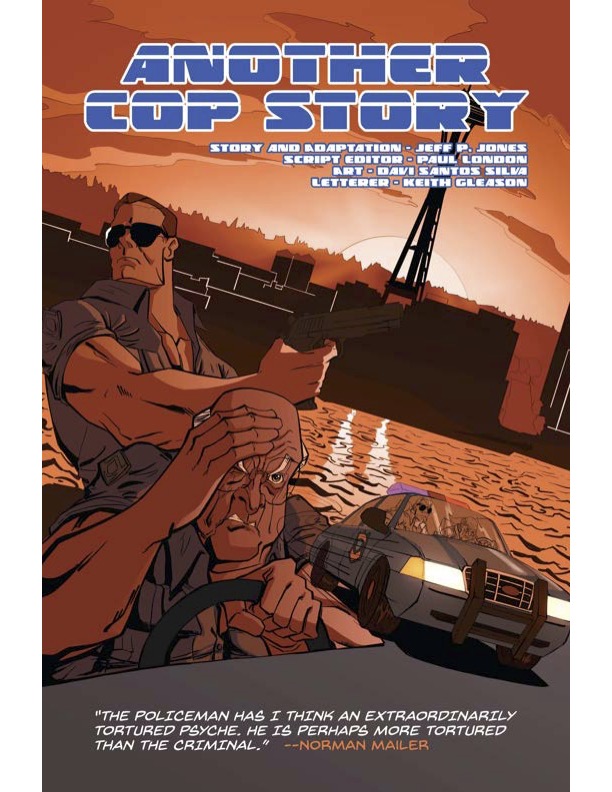
Here's a page from the script that I'm currently adapting, "Another Cop Story."


Friday, March 5, 2021

Script vs. Finished Page


Here's a page of the script and AJ's finished page. On p. 3 of "Tribute" the Stuntman is just waking up from having accidentally knocked himself out while practicing his fall from the post. 


Thursday, February 25, 2021

Sunday, February 7, 2021

See Reference Image

As a child of the 80s, it still amazes me how quickly our world gets cataloged for the eyes, and that there are all these folks out there continually uploading images of rusted-out trailers, green hallways of corn, military uniforms from every era and branch of service, archived photos of Ventura Boulevard in the 1940s. 

In the pre-internet Before Times, to find such visual specificity for even a single useful reference image would take hours (walk to the library, find a computer terminal, scratch out the call number, begin the hunt through the book stacks--not that I don't LOVE this process, of course). Even given a whole day in the library doing analog research, you could never turn up the plethora delivered in less than a second by a simple google search. 

The application for comics scripting? Reference images. The scriptwriter speaking to the artist visually.

Reference images have the added benefit of making the script itself more efficient. You can spend a precious paragraph describing the exterior of a house as you imagine it, or you can simply write, "See reference image," find a house on google images that's close to the one you picture, and attach it.

So far I'm keeping a separate "Images" file for each script. Below are some of the reference images for Tribute. The full reference file for that story, a comic of thirteen pages, is fifteen pages, with one to two images per page. 

I'm still refining how the search for reference images gets incorporated into the process of scriptwriting. Even though the search itself is nearly instantaneous, poring through the numerous results, refining the search, delving down through the various pages to find that perfect single image, can be tedious.

It can also be a terrible distraction. Often I'll just make a note to find the actual image later and keep typing. 

And noticing this just now--looking at the images separately from the script but in sequence, they still tell the story in their own way. 

It's like reading only the final word on each line of a poem--you still get a flavor of what the poem's about.

And a final note--artists are grateful for reference images. It simply saves them time. Who wouldn't be grateful for that?


Tuesday, January 26, 2021

Emotion, Vulnerability, Destructive Voices

I found Taylor Swift's movie Folklore: The Long Pond Studio Sessions profoundly moving. It's filmed intimately and largely without artifice. It also speaks powerfully to the moment inside the pandemic in which we find ourselves. 

"It's an album that allows you to feel your feelings," Swift says at one point.

I came across the movie unexpectedly and knew little about Taylor Swift--passing headlines, the occasional pop song, an ad she did for Coke, an article I read about her queer fans poring over her lyrics. The result was that I was unprepared (or perhaps perfectly prepared) to be walloped by her creation.

The feeling was so powerful that I became interested in my own response to the movie. How much of it had to do with being in a vulnerable state, as we all are at some level inside the pandemic? And how much of it had to do with Swift sort of going for it?

So, yeah, just interested in that dynamic of working on a project and hearing all these editorial voices, many of them destructive and desirous of killing the creative fervor. There are so many reasons not to write anything, and a lot of what I find myself doing these days is bantering in my head with these voices, reasoning, cajoling, dismissing, conceding, then reengaging. 

I think such voices can be important at times to listen to in shaping the story, but if the story has its own emotional energy, it still needs to exist. Readers don't have to read it. 

Here's a page from Frankie B of Night Deliveries. His artwork is impeccable and stunning, IMHO. 

A lot of voices pinging me on this story; it feels vital. I'm going with the vital. 


Bloodshot World Review in No Flying No Tights

Though I had sent No Flying No Tights a copy of Bloodshot World , I hadn't heard from them, so I expected nothing. But when I checked, ...